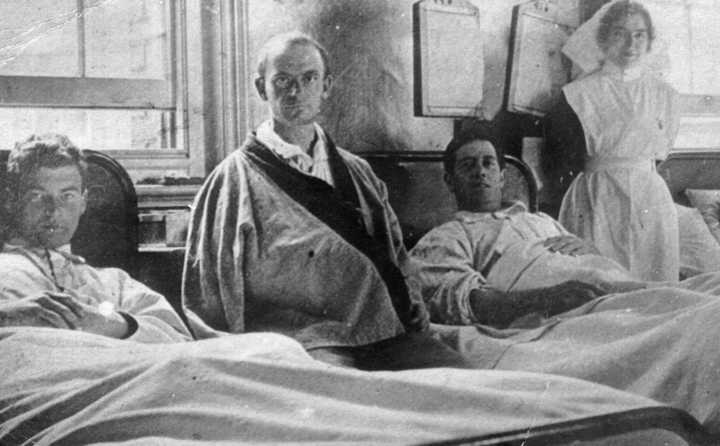
Whilst caring for my elderly Grandfather and helping sort his archives I found this letter amongst many in shoeboxes; it was written in pencil (for the censors) on 17 tiny pages held together with a rusty little brass safetypin within a time-stained Red Cross envelope. I was in tears halfway through reading it, later showing it to my father who immediately confronted Grandpa demanding to know why he'd never seen it before, "Pop, it's going to the War Memorial in Canberra" which is where it can be referenced today. I've since forwarded them this digital translation for the benefit of younger generations that find difficulty in reading "joined up writing". He (1897-1991) is left in the photograph and barely 19. A Battalion was 1,000 men and over 6,000 served in that Battalion during it's fours years of war - 23rd Battalion (2 Division), Brown & Red patch ("Mud & Blood").

Mr H.H.Hocking
341 Collins Street,
Melbourne

September 29th 1916

Charge at Pozieres

County of London War Hospital
Epsom, Surrey. England
Thursday 17/8/16


My Dearest Dad,
         It is a good while since I wrote to you but before I left France we couldn't write much as we had been moving about so much and since then it has not been easy to write as I've not had anything to write with until the last day or so. I hope you got my cable safely. Why I asked for some money was because I'll be likely to be at a convalescent camp a long while with this leg and the authorities wont pay convalescents.
    It will be as well to address my letters to C/O of Aust. Offices 130 Horseferry Road, London SW. as they will be forward then to anywhere necessary.
    I hope you are all keeping well & that business is fairly brisk. Spring will be coming on now in Melbourne whilst here Autumn is coming on. We are all family, when I say "we" that is the four in the photo I sent you, taken by one of the nurses, about five days ago.

    My leg is getting on well and will soon start to heal now. The weather here is pretty warm and it would be nice to get outside a bit, but I've only been down to Epsom once, when 12 of us went to tea at a place there and had a nice time. I can get about inside in a bath chair all right so I'm not tied to bed altogether although I've got to stay in bed most of the time; while I have this rubber tube through my leg; but I'm hoping they'll take it out and leave it out shortly and then I'll be able to get about more.
    I'll give you a short account of our doings during the fortnight ending July 29th to tell you how we down to Albert, before giving you an account of our experiences at Albert. On Monday July 3rd we left the Armentieres trenches and went to Steenwerck about 8 miles away. We left Steenwerck on Saturday 8th and marched Saturday, Sunday and Monday to Wizernes near St. Omer. From Wizernes we entrained and went up through Calais & Boulogne to Amiens & billeted at Ailly Su Somme. We left Ailly on the 16th July & went to Raineville , Left Raineville 18th & went to Puchvilliers. On the 20th we went to Lealvilliers where I wrote you from last. This truly a tale of tramp tramp tramp isn't it?
    Lealvilliers is just near Albert & the big guns weren't far away, so we got plenty of noise and fireworks, although we were only in reserve.
    On Wednesday 26th we got up at 3.20 and left at 5 for Albert which we reached about 9 and where we stayed all day. Here the story starts, that night we went up to the reserve trenches and slept anywhere anyhow if we could sleep. The big guns were roaring and bellowing without stopping night or day and our own artillery was enough to drive us silly with the frightful noise although we'd been used to a good bit in the way of big gun fire. Here we saw a lot of our other battalions that had just come out or rather the survivors in the case of the 10th Battalion who charged, only 46 came out. " Oh, they said "Don't worry, you'll all get skittled". Fine cheer this was. " In a charge up there, they said the first wave gets cutdown to the last man."
    This heartened us up still more for we knew (our platoon) that we were in the first wave.
    They didn't leave any battalion in longer than four days and at Pozieres they reduced even this and only left our fellows in about three days as it was impossible to stand the shell fire.
    The next day Thursday we spent the morning in looking over the old battle field of the first days of the push. The trenches were torn to pieces, the German dugouts full of unburied German dead and there were bits of men lying about the battlefield. It is impossible to describe it but still; although we knew we'd be in it in a day or so we didn't care and we were anxious to get there. It felt as I looked over to Poziers where the shells were bursting "thick & heavy" as if I didn't care what happened, my senses were numbed.
    Thursday afternoon we went up still closer and Thursday evening a party from our lot went up to the front line with provisions for the battalions then in. We had left our packs at Albert & only had our overcoats & weren't getting much to eat; they put, on Friday after a miserable night 18 new batteries in near us and these on Friday nearly drove us mad. Friday afternoon the order came out, Attack at Poziers 12.15 A.M. Saturday morning" The bombardment they were to have before we charged was to be most terrific, surpassing anything given up till then during the war; it was said as there were about 2,000 big guns of all sizes behind us; made up as follows15 inch howitzers, 12 inch howitzers, 10 inch howitzers, 12 inch naval guns, 9.2 inch naval guns, 9.2 inch howitzers; 8 inch howitzers, 6 inch howitzers, 5.2 inch field guns, 4.7 inch naval guns, 4.5 inch howitzers & 18 pounders.
    This is a list that mightn't convey much to you but any one whose been under them; will know what they can do. The thought of a ten inch shell or such like conveys little to any one who hasn't seen them burst at close quarters but to any one who has been under the big gun fire, a ten inch shell means a "bottled volcano" & earthquake combined.
    At about 6 o'clock on Friday evening we were told off in charging formation. Another chap and I were the two leading men of a bombing party that had to clear a German trench out. Everyone else grimaced & wanted to bid us good bye but they needn't have done so because they all got it just as badly. At about 8 o'clock off we went into the front line with shrapnel & high explosive bursting everywhere (One of the other battalions had fifteen men killed with one shell on the way up).
    We were all loaded up like pack horses, rifle & bayonet, 220 rounds of ammunition, 4 bombs, 2 sandbags, water-proof sheet, haversack with two days rations in it, two bottles of water and every man had a shovel & every sixth a tin of water.
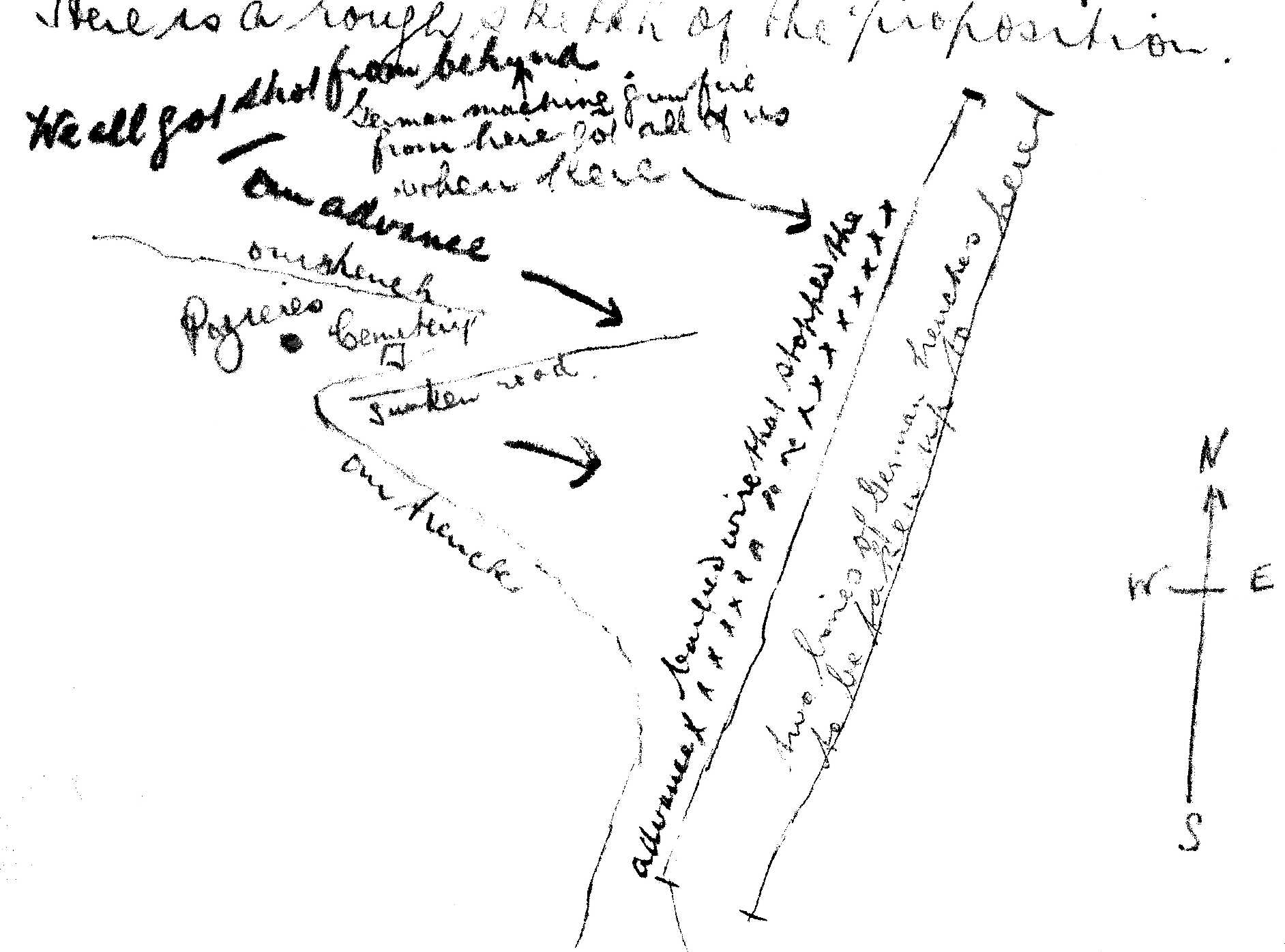
    Here is a rough sketch of the proposition.


    The idea was to take the trenches shown, four battalions assaulting. We had the left hand side to do & had to dig in from the last of the cemetery over to the German lines and so form a salient. Our party had to clear the German trenches and block it.
    The idea was excellent. We had to advance about thirteen hundred yards to reach the German second line. There'll be very few men in the trenches if any" said our Major. Oh dear "not arf" as the Cockneys say. Well we got up into position all right, at least most of them did.
    A party of us with some ass in the lead got lost and and went along a branch trench for about a mile. I never felt so annoyed in my life. At last after roaming about mid shot & shell we found the rest of the company all lying out in the open. It was a frightful place with no trenches, only shell holes. On every inch the ground a shell had fallen and churned it up. Our guns were roaring & belching, the German guns were also roaring, machine guns were rattling and star shells were bursting. Altogether a terrific sight.
    As a quarter past twelve approached the bombardment swelled out to unbelievably terrific proportions; the ground rocked & reeled under the terrific rain of shells as the 2,000 guns belched out on the German position. It was like the climax of a thunderstorm of hell.
    Suddenly the order came "First wave get ready", up we got "Fix bayonets, advance". As the long line swept forward the thing that was to wreck the attack happened. On the left broke out the crackling of German machine guns while not a few started from the German trenches ahead; where we were making for; and where it would be thought a fly could not have lived.
    You might think it impossible for there to have been any humor in such a sight as our advance but there was. We looked ludicrous as we waddled forward falling into shell holes "Get off the "blanky" road" roared the Major. I ran up one bank & fell into a shell hole on top. I ran down the bank & fell into another shell hole at the bottom. I'd heard of men going mad in a chaye of "seeing red". Practically all our fellows did; but I never; a kind of cold coolness, so to speak was on me; I felt the same as I do now as I'm writing this; only I didn't care what happened to me. On & on we went; it seemed miles, the bullets whistled past me & men were falling everywhere but I took no more notice of them than as if they were in another world.
    A fellow I know well went down next to me with a despairing yell; which made me turn my head & notice him. (I met him after at the dressing station not hurt much) but of the 200 who started in the first wave only about forty or so were now left. Our Major was ahead roaring out "Come on 23rd"; although we didn't need any telling for we were barging along as fast our loads would let us.
    All of a sudden we saw the Germans, my first chance to get at them in just on five months. The few of us who were left bolted on; we felt equal to attacking a battalion of Germans; there seemed to be a battalion; they waited until we were within about twenty yards of them; then threw a battalion of bombs at us, they went off in a wall of flame a few yards in front. One burst under my very feet & never hurt me; still we ran on.
    Young MacDonald who was with me roared out "There the (shocking frightful unmentionables) are Fred". He was as mad as a tiger. He shook his head like a great dog. "Right, I said stick the bayonet into them, take no prisoners".
    But the Germans ran like rabbits. I saw them tearing back across to their other trench, my greatest desire in life was to kill one. The dozen of us that were left set after them (indeed we hadn't stopped). Then biff. I was lying on the ground. The Machine Guns were crackling over head and thousands of bullets were screeching just above me and had I been up then I should certainly have been riddled.
    I'd like to have a talk to those people who said bullets didn't hurt when they hit one at first. I lay on the ground and stuck my fingers into it and literally "bit the dust" for about five minutes. After that it seemed to go red hot numb. The machine guns having slackened a little, I looked at my leg. Little spurts of "bleed" were coming out. I was beautifully optimistical, "I'm done" I thought, but I undid my putty & bound it round tightly; and taking a full bottle of water from my equipment, started to make a bold bid for it, as they say in the novels. Our fellows were lying everywhere in every shell hole they seemed but few of them thought of crawling in.
    As soon as I started to crawl my leg started to give me what for with the rough jerks I had to give it. I'd gone what must have been about 100 yards but what seemed like a lifetime journey when I found one of our sergeants in a shell hole, a chap I knew well. He had two bullets in him; one in the arm, the other through the leg. They were only flesh wounds however and he could crawl better than I. We hailed each other with delight & started off afresh. It seemed a terrible journey in but its marvellous what a man will do when life is at stake & we at last reached the trench where the remainder of our battalion had dug in. They were the only battalion who reached their objective. The other battalions were held up by much barbed wire; the machine guns meanwhile playing on them. Only a remnant got back. About 150 of our fellows were left unwounded at about two o'clock that morning when I left them, a stretcher bearer of our company binding up my leg & assisting me back to our own lines. The stretcher bearers are the men who should get the praise. They worked splendidly under fire & were shot down right & left. The man who helped me in; immediately went back and was killed. S.B. on the arm meant "Splendid Bravery" at Pozieres.
    Two or three fellows helped me back to the dressing station which we reached about three o'clock. We were soon in the ambulances & soon back far behind the lines at the casualty clearing station at Puchvilliers where we'd been billeted such a short time before. That night I had an operation on my leg & a tube put through. It never affected me at all & next morning I woke up feeling that everything was a dream. My leg was all right & I never felt the effects or loss of blood at all. All I had was the usual complaint, a vast appetite.
    We stayed at Puchvilliers all Sunday & Monday morning were sent to Boulogne by Hospital train. At Boulogne I went to the third Canadian General Hospital a lovely place all big tents & everyone as nice as possible.
    We stayed there until Thursday morning & were then put aboard the Hospital Ship "Cambria" & went to Dover, Dover was reached about four o'clock & we were at once put aboard a hospital train. Leaving Dover about 5.30 on a perfect evening, we had a beautiful run up through Kent to London.
    London was reached about 8 o'clock & through we went to Epsom reaching here about 9 o'clock; just dusk.
    Epsom is a fairly nice place and this hospital is fine with splendid food.
    "Yes" said another 23rd man here. "A man is as lucky as a Chinaman to be alive after that "Perhaps "lucky" perhaps something else.
    Well I'll have to bring this to a close for this time. I've not been doing much writing since I came here but I'll have to try and buck up now.
    My leg is getting on famously & ought soon to heal up. I can hop about & am up but it will be a long time before I walk again.


Good bye, just now,
 God bless you all,
    From your
     Loving son.
      Fred

P.S.
I omitted to tell you I was shot through the leg from behind the bullets coming through from rear to front. FRH.

  The village was captured initially by the 1st Division on 23 July 1916. The division clung to its gains despite almost continuous artillery fire and repeated German counter-attacks but suffered heavily. By the time it was relieved on 27 July it had suffered 5,285 casualties.
  The 2nd Division took over from the 1st and mounted two further attacks - the first, on 29 July, was a costly failure; the second, on 2 August, resulted in the seizure of further German positions beyond the village. Again, the Australians suffered heavily from retaliatory bombardments. They were relieved on 6 August, having suffered 6,848 casualties.
  From the site of the old windmill at Poziere today is a commanding 360 ° view dotted with scores of cemeteries, the graves of 100's of 1,000's of boys and young men.